

If you were talk to Mikel Arteta I think that he would answer you that his focus relies more on “difference maxing” and trying to exert total control on a match.
Arteta possesses a relentless focus on pulling all of the levers to eek out marginal points. His tactical philosophy and game model has landed on territory control/dominance, world class out of possession defense limiting opposition transitions (even if that limits Arsenal’s as well), and a focus on creating high-probability chances over volume.
It is hard to argue with the results and Arsenal find themselves experiencing their best period since the early 2000’s.
This doesn’t mean that it doesn’t cause some frustrations within the fan base, many of us have the memories of Arsène Wenger’s Arsenal burned into our minds. Those teams played innovative and exciting attacking soccer, even when the team dropped into the “top 4 is a trophy” era, we could still hold on to seeing great attacking teams. This is the modern heritage of our club and it is important basis for why Arsenal were able to grow into one of the largest clubs in the World. There is probably some rose colored memories here and the rough edges of the defensive fragility sanded off but I understand the frustration that what Arteta has Arsenal doing now, favors other priorities.
Compounding the worry from historic comparisons, there is some justified worry that in the summer Arsenal got weaker in attack. Arsenal lost attacking depth and talent losing Leandro Trossard, Gabriel Martinelli, and Gabriel Jesus while they only brought in Christos Tzolis, failing to get the marquee attacking player that they hoped for.
With frustration comes exaggeration and a focus on any negative data points.
Where does the actual truth lie?
What the numbers say
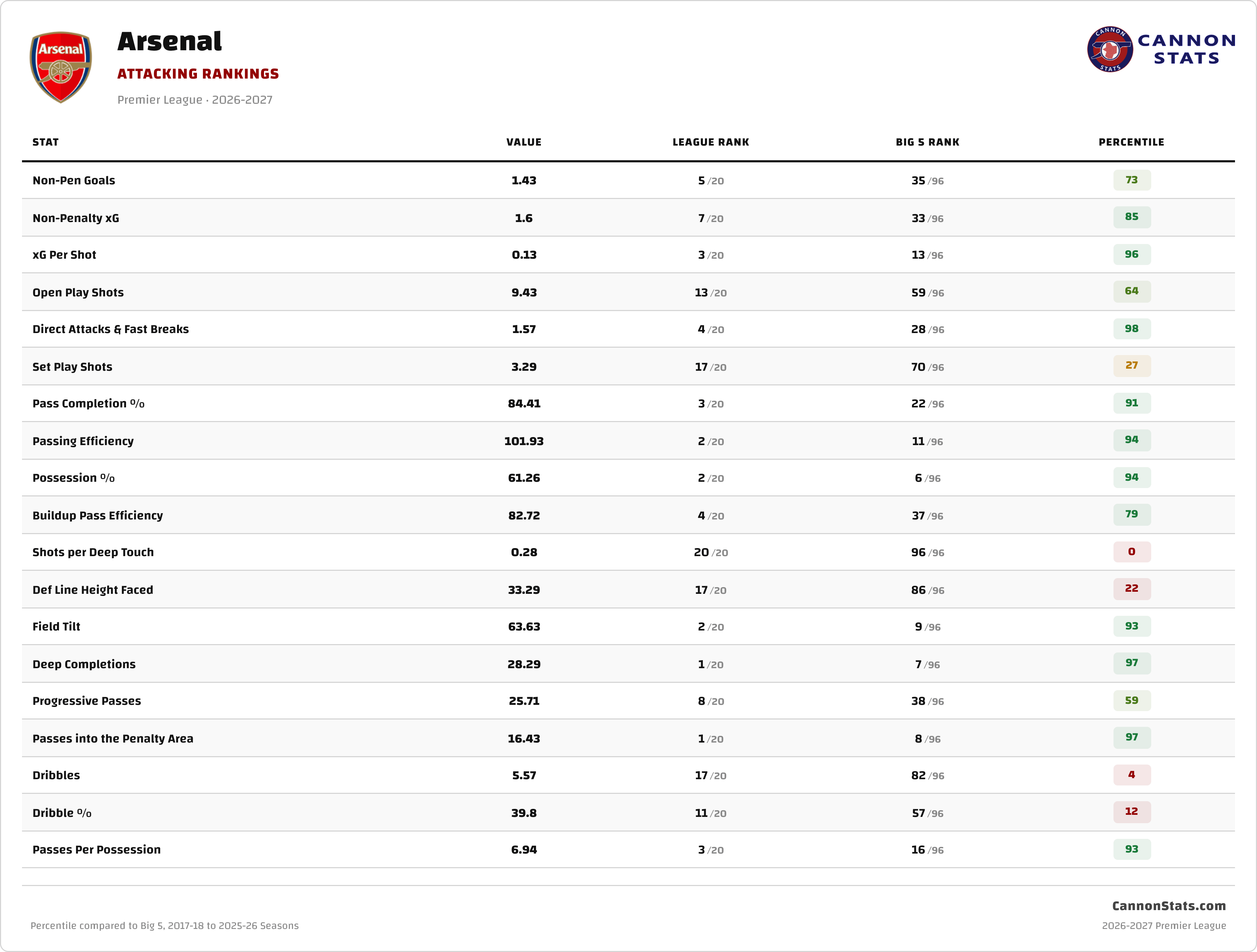
This season Arsenal haven’t exactly lit the world on fire in the Premier League from a pure scoring standpoint.
Their 11 goals still put them above average ranking tied for 5th, with the overall numbers looking like a team that is much more in that above average rather than excellent category.
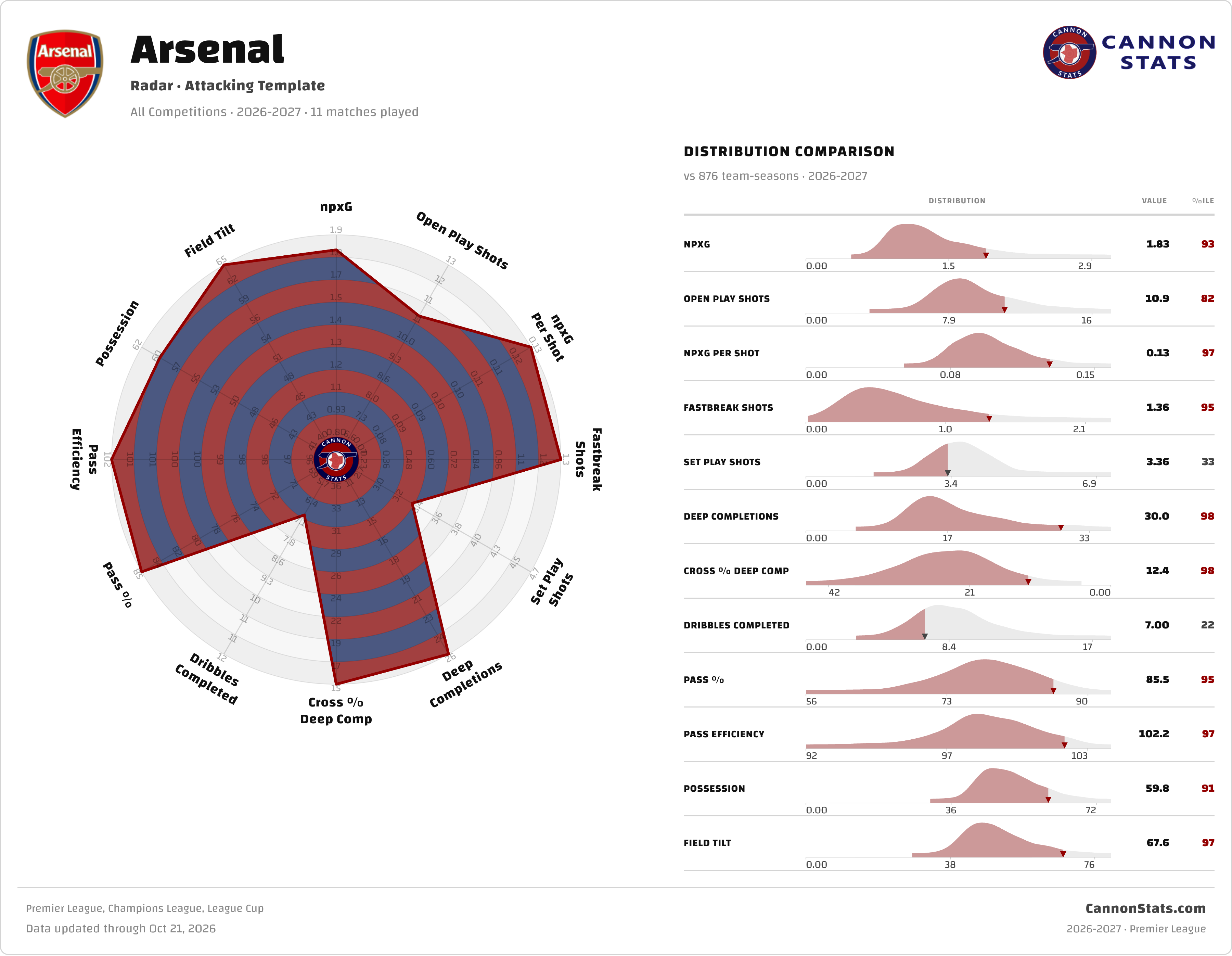
If we expand the sample size to add in the matches that Arsenal have played in all competitions the numbers improve and Arsenal look much closer to a “good” attacking team.
Looking at the bigger and longer term trend backs this up and counters the idea that there is a systemic issue with Arteta’s ability to be able to coach a team that can generate a good attack.


Over the past five season’s Arsenal’s numbers look quite strong and even the harshest critic would have trouble supporting their position that this is mediocre or only average.
If you were bullish you could push that they have been consistently 2nd or 3rd best, if you were tougher maybe you’d say more like 4th or 5th, regardless this sticks them in the upper quartile of attacking teams in the strongest League in the World.
Arteta’s obsession with control is correct
Arteta’s style makes an explicit sacrifice that has a direct effect on the team’s ability to generate more scoring opportunities. He willingly makes the trade-off to favor more control and have his team set up to stay in their structure to prevent the game that Arsenal play turning into a transition heavy vertical game.
Team’s look to set up to be able to defend and counter against Arsenal and during Arsenal’s run here at the top, even with this being the dominate strategy that teams employ against them, they struggle to find any success doing so.
This helps feed into Arsenal’s awesome defense but it comes at a cost.
Arsenal under Arteta have not been defensive, at least not in the classic sense of how we would think about a “defensive” team. Arsenal rather employ what I think of as the anaconda attack; they want to squeeze the opposition and ultimately suffocate them, creating overwhelming pressure that leads to them breaking through scoring goals.
This is visible in a number of metrics, Arsenal dominate field tilt, they force teams deep into their own half with very low defensive line height faced, they attack with patience with slower ball progression speed up the field and more passes needed to generate shots, they hunt good shots over relying on volume, and they generate tons of set play opportunities and chances.
Friend of the newsletter Between The Lines wrote up some very interesting and persuasive experiments on the tradeoffs between attack and defense and which ones actually help you win more.
In part one, he made the case that you’d rather have the strong defense.

The plot tells us that the better your defence is, the more points you can expect to get. The flattening curve emphasizes that limiting xGA matters more than increasing xG. Although, it’s worth remembering that this is within the context of maintaining the same xG/D - a team with +2.0 xG/D with 2.75xG/0.75xGA is going to outperform a +1.0 xG/D team with 1.5xG/0.5xGA.
I found this to be a bit of a counter intuitive finding but the experiment and the data were hard to argue with. The missing portion that I think people (including myself) missed here was that the stronger defensive team was outscoring the opposition by 3 times as often, while the better attacking team was only doing so at a 1.6 times rate. A higher scoring rate than the opposition is superior for accumulating points.
In part two of the series he took the analysis a step further, here he further refined the experiment to more closely resemble real life and gave us estimates of the marginal values of moving between different trade-offs between attack and defense.

On average, an +0.1xG increase is worth 1.92 points, whilst a -0.1xGA decrease is worth 2.52 points. This means that the ratio is 1.31x - lowering your xGA by 0.1 is 31% more valuable than increasing your xG by 0.1.
In addition to this, a lower xG allowed leads to less volatility in outcomes and more certainty.
The overall conclusion to be taken from this is that Arsenal’s and Arteta’s choices are actually following the optimal path. A team should be trying to maximize the overall difference (duh) in total chances in a match, but they should do so while trying to keep their defense as strong as possible.
Final thoughts
I don’t outright dismiss people that have frustrations about Arsenal’s attack. It is fair to say that it is not the strongest, nor is it the best. In the Premier League Manchester City and Liverpool have been consistently better, in Europe Barcelona, PSG, and Bayern have all been stronger as well (with some caveat for the opposition they have faced). Arsenal have been in the tier below these teams, where they are a good attack but not a great attack.
Part of why we watch this sport is that it is entertainment. We want to see teams produce goals and fun attacking moments are more entertaining than great defense or pitch control. We also want to see our team win more often and to lift silverware.
For a coach/manager, their priority is almost entirely on winning and the entertainment factor is at best secondary to the first goal.
For Arsenal and Arteta, they believe that the mix of attack and defense that they have landed on gives them the best opportunity to win points and trophies. I am sure that Arteta would be happy to see Arsenal score 3-4 goals a match but not if that meant that it was at the expense of conceding more good chances.
Arsenal want to be the team that maxes out the difference over the opposition but looking at this graphic below, they would rather be favor being in their current position than being out to the right side.
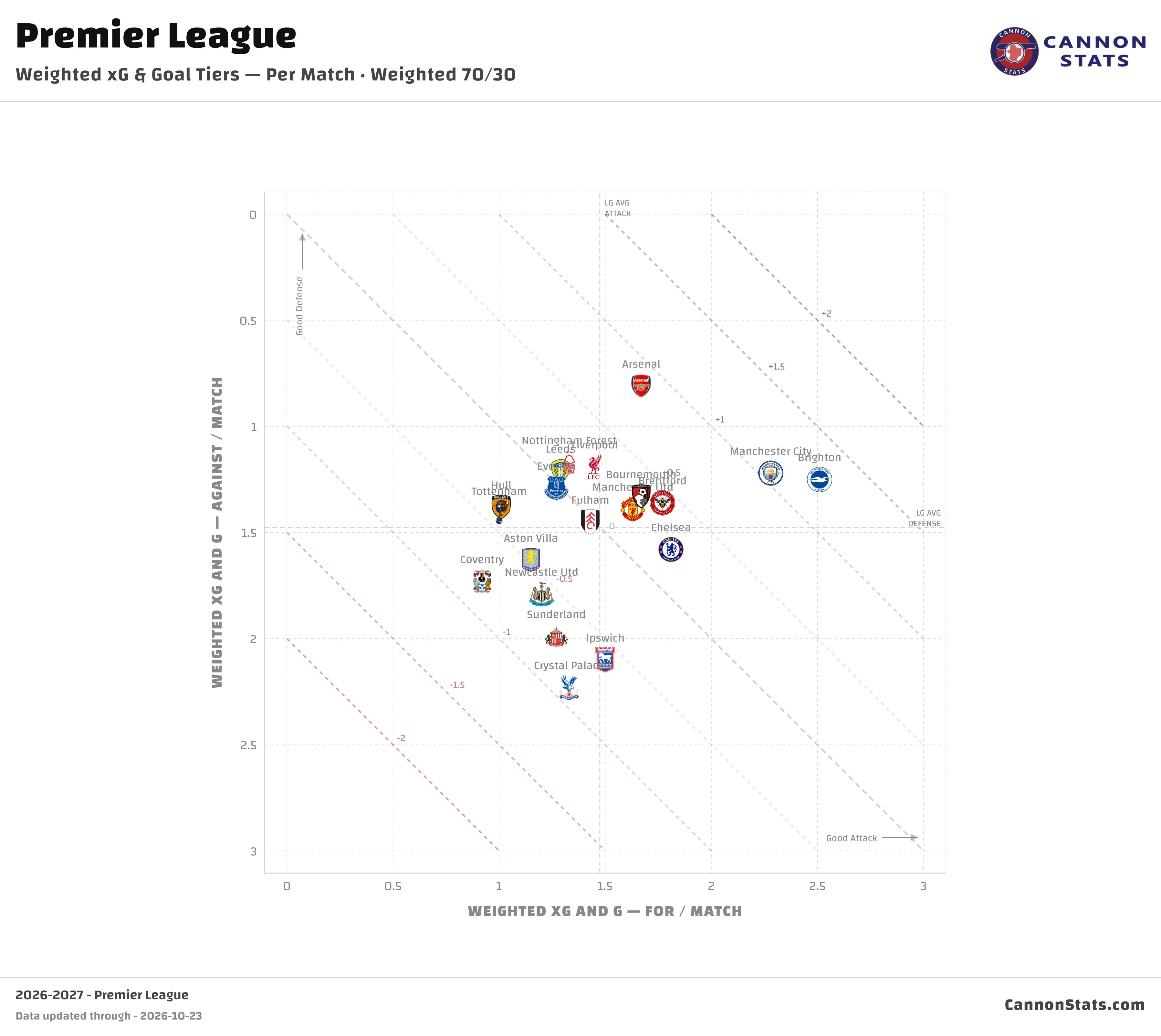
An attack that can produce 1.6-1.8 non-penalty xG per match alongside an elite defense that holds teams under 0.8-1.0 allowed is a recipe for winning a lot of matches. We’d all love to see the attacking number go higher, but as we have learned we don’t want to see that at the expense of giving up more opportunities to our opponents.
It would be ideal to marry an elite attack with an elite defense, but the next best outcome is to have a very good attack and an elite defense and that is exactly where Arsenal find themselves.
I believe Odegaard is what stalls our attack. He often times doesn’t allow for other players to take advantage of positions and spacing created because when in and around the penalty area, he dribbles across the entire pitch taking up positions that players should be occupying just dribbling searching for 1, 2 touch passing. While it at times works out it misses more than it should and we see other players execute it better. Now I’m not saying don’t play the captain, I’m saying after watching him play for 5 seasons and seeing the struggles attacking, but that pass rush on Wednesday as a deep lying playmaker gave me an idea. Maybe Odegaard as the 6 and the shield in front the back line might not be a bad setup. While he’s not Rice defensively he’s not a bad defender. He often drops deep to get the ball, this way he’ll be able to progress into two hard running 8s and bring out the best parts of their game, he can also hit through balls to the wings and 9. This would be almost like he plays for Norway, and most people forget in their criticisms of Gyorkeres he’s Haaland lite. We just don’t play him like Pep changed his team to fit and Arteta would learn to at least try now that Saka appears to be out for a long stretch. Havertz hasn’t scored in last 2 months and he sure isn’t playing like you need from position. He’s not even doing the things Arteta praises him for decent right now. This is how we see how good of a coach Arteta really is. Better yet this is where we get to see how stubborn he is.