

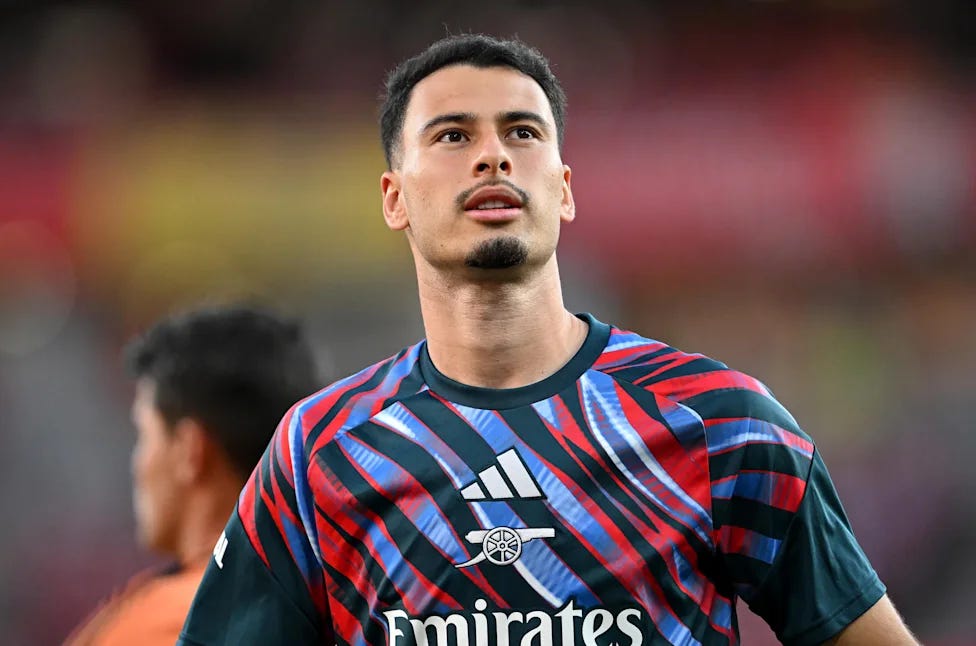
There is a version of this conversation where Arsenal supporters convince themselves that Gabriel Martinelli is not that good anyway.
That would be a mistake.
Arsenal are set to receive roughly £56.5 million from Al Hilal, with add-ons included and potentially a future sell-on percentage, the kind of offer that forces serious consideration. Martinelli is a very good player. He is also 25 years old, valuable, and occupying one of the positions where Arsenal have the clearest pathways to replacement.
Those things can all be true at once.
On a purely financial level, this looks like excellent business. Arsenal would be receiving a fee that is difficult to turn down for a winger who, despite remaining highly productive, has not fully recaptured the headline numbers of his 2022-23 breakout campaign. The club would also create meaningful flexibility, both in the short term and over the remaining years of Mikel Arteta’s project.
But if Arsenal do pull the trigger, let’s not rewrite the story of the player on the way out the door.
One of the more persistent narratives around Martinelli over the last two seasons has been that he plateaued after scoring 15 Premier League goals in 2022-23. Depending on who you ask, he either stopped developing or outright regressed.
The evidence for that claim has always been thinner than many people seem willing to acknowledge.
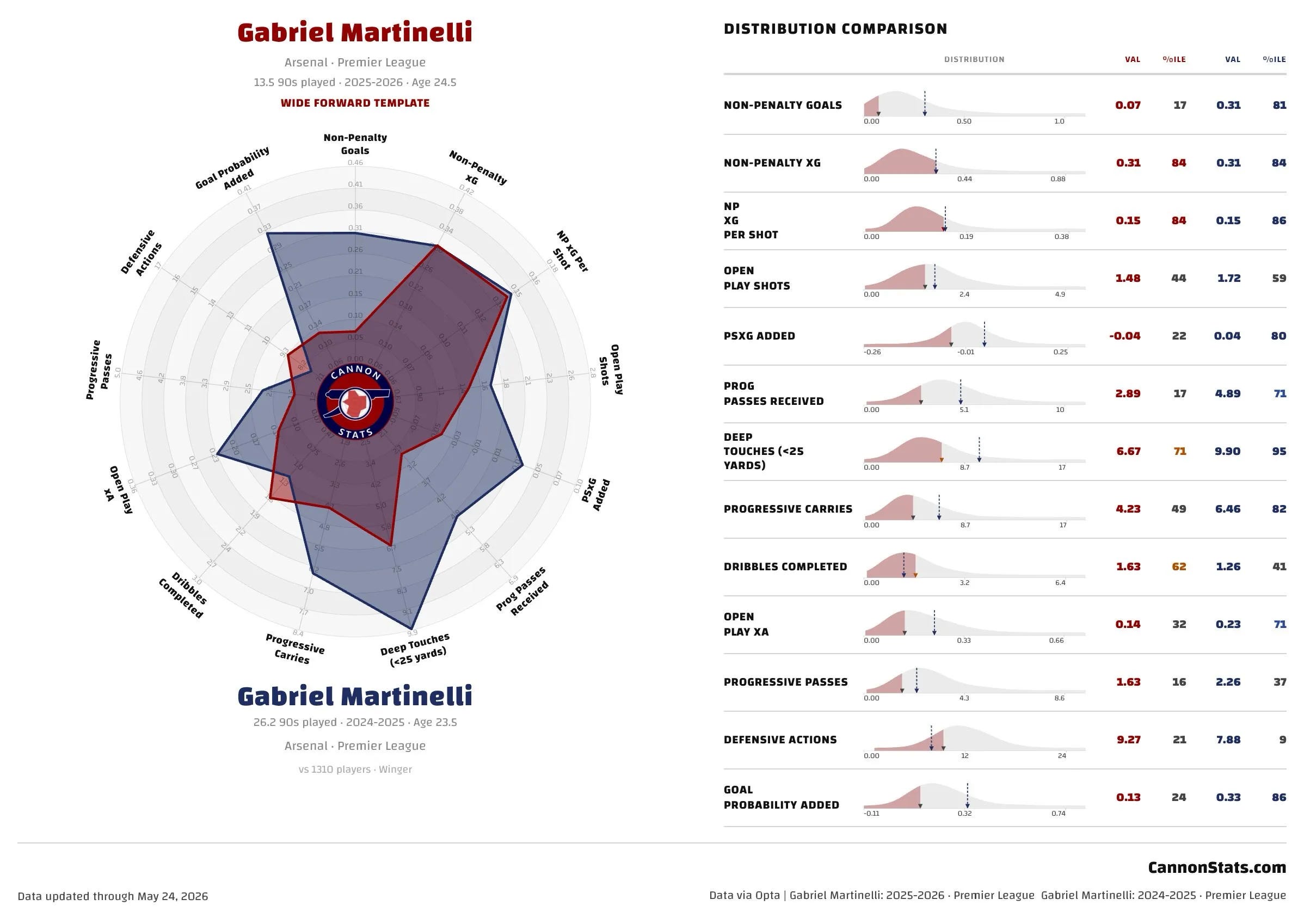
In fact, three charts tell a different story entirely.
When comparing Martinelli’s 2025-26 and 2024-25 seasons, the first thing that jumps out is that the underlying chance-generation and chance-arrival numbers remain almost unchanged. Non-penalty expected goals stayed at 0.31 per 90. Expected goals per shot actually improved slightly. Deep touches, progressive carries and goal probability added all remained at strong levels.
The finishing, however, cratered.
Martinelli’s non-penalty goals dropped to 0.07 per 90 despite producing virtually identical xG. His post-shot xG added plummeted. That’s not necessarily evidence of a deteriorating player. Often it is evidence of variance, form, confidence, or simply a cold streak, particularly for players who are on the whole better than their most recent numbers.
The same exercise becomes even more interesting when comparing Martinelli’s current outputs with the season everybody uses as the gold standard.
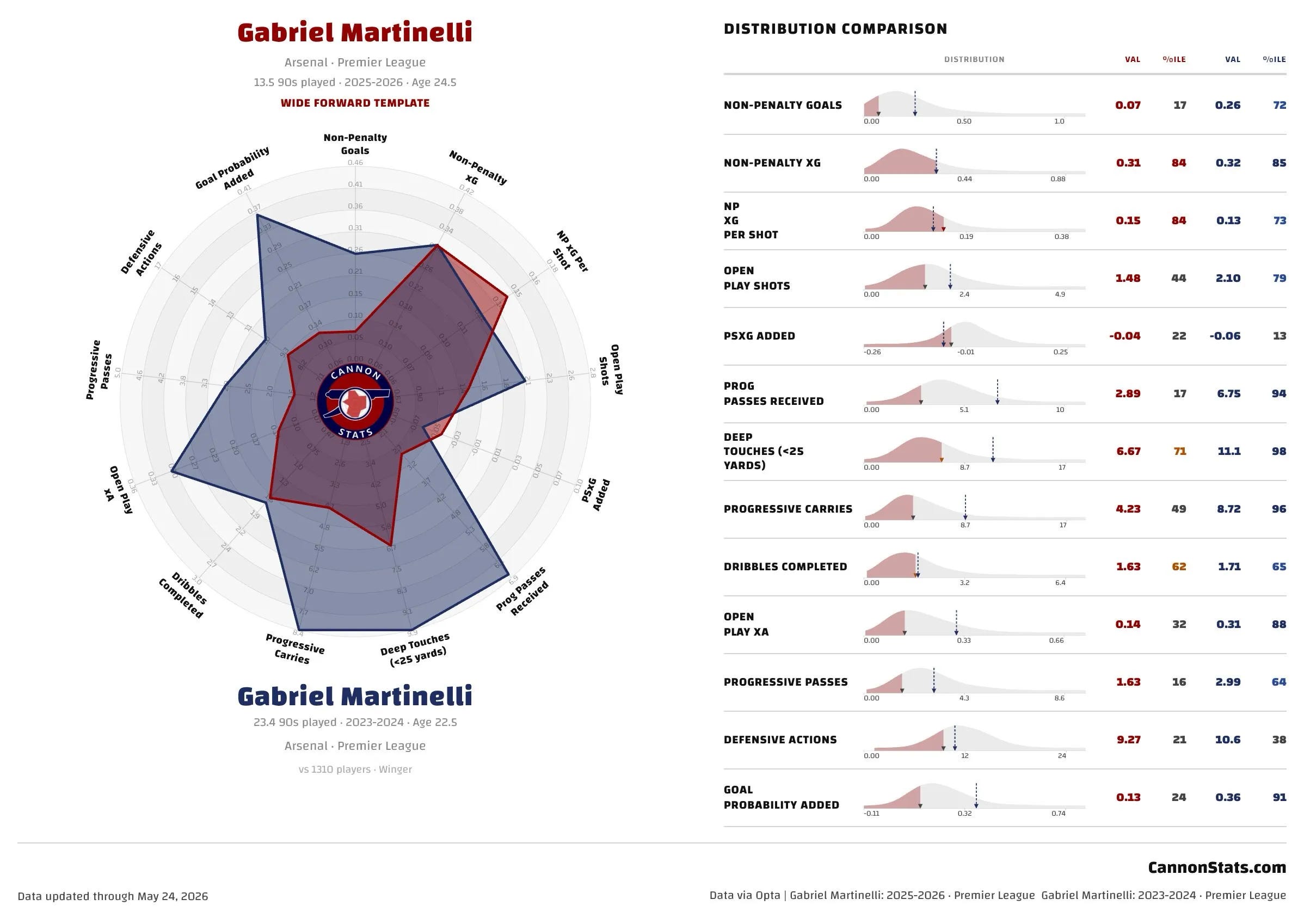
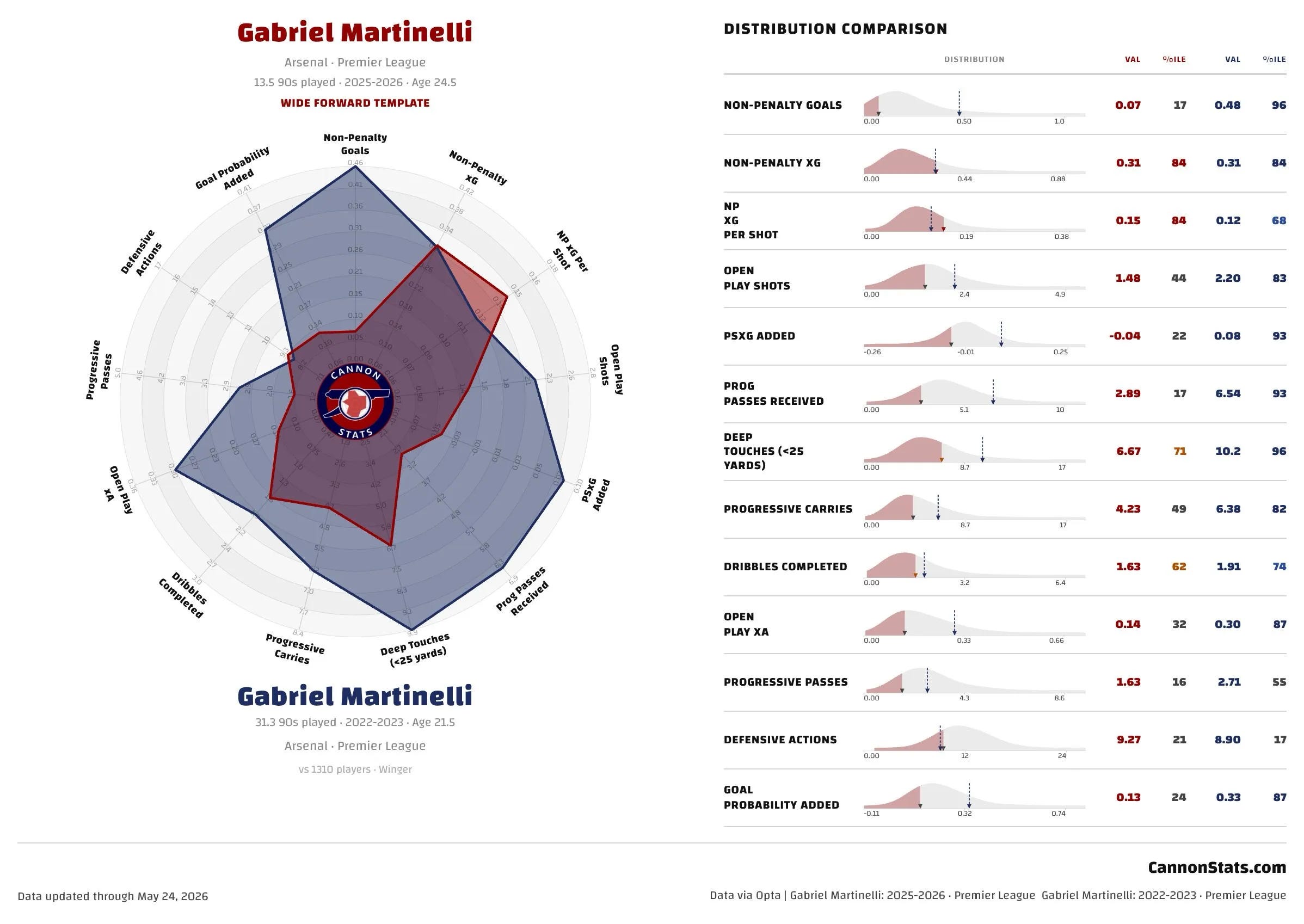
Yes, the 2022-23 version of Martinelli scored far more goals. Nobody disputes that. But many of the underlying indicators are remarkably similar. The current version still generates non-penalty xG at almost exactly the same rate. He remains heavily involved in dangerous touches, progressive carries and final-third actions. In some areas, particularly ball progression and defensive involvement, he has arguably become a more complete player.
That is not what a collapsed player profile looks like. The 25/26 dropoff would elicit further investigation from any good scout, be it professional or by hobby, and the Martinelli story would undoubtedly revolve heavily around his consistent play next to two players who don’t suit his playstyle in Noni Madueke and Viktor Gyökeres (to say nothing of the 20% drop across the board in the PL and the additional absence of Martin Ødegaard).
Honestly, if somebody approached you with the following sales pitch, many Arsenal supporters would probably be interested: Can I interest you in a 25-year-old winger with elite speed, a 15-goal Premier League season on his resume, 10 Champions League goals in roughly 25 full matches worth of minutes, strong defensive work rate, and underlying chance-generation numbers that remain comfortably in upper-tier territory?
The answer would almost certainly be yes.
The reality is that Arsenal have reached a stage where marginal gains can be enormously expensive. If the club genuinely believes it can replace Martinelli’s output while simultaneously upgrading the squad elsewhere, then a fee north of £50 million becomes incredibly powerful. It can help fund another attacker. It can create future room for future signings. It can improve overall squad flexibility.
Those are legitimate benefits.
What I struggle with is the idea that this would represent the obvious removal of a weak link.
Martinelli has spent much of the past two seasons in circumstances that were not particularly favorable. Arsenal battled injuries. The left side often lacked continuity. Different midfield combinations altered the dynamics around him. At various times he was asked to function as a width provider, transition threat and isolation winger all at once.
Even then, the underlying numbers largely held.
That matters.
Another question here is whether the removal of a guy who’s at the very least still in the conversation for best left sided attacker at the club without an obvious replacement is a responsible move. My best guess is that Arteta, in the absence of another wide signing, would rely on Ebere Eze and Noni Madueke to split minutes with Christos Tzolis, who so far looks great in red. Whether that is enough, time will tell.
Maybe it is simply time for a change. Sometimes players and clubs reach that point. Sometimes the fee becomes too good. Sometimes a squad evolution requires difficult choices.
If that is where Arsenal are, so be it.
But should Martinelli leave, I suspect there is a fair chance we will spend the next couple of years being reminded why clubs such as Bayern Munich and now Al Hilal were willing to invest so heavily in him.
Arsenal may be making the right decision. That does not require pretending Gabriel Martinelli stopped being a very good footballer.
Best wishes, Gabi.