

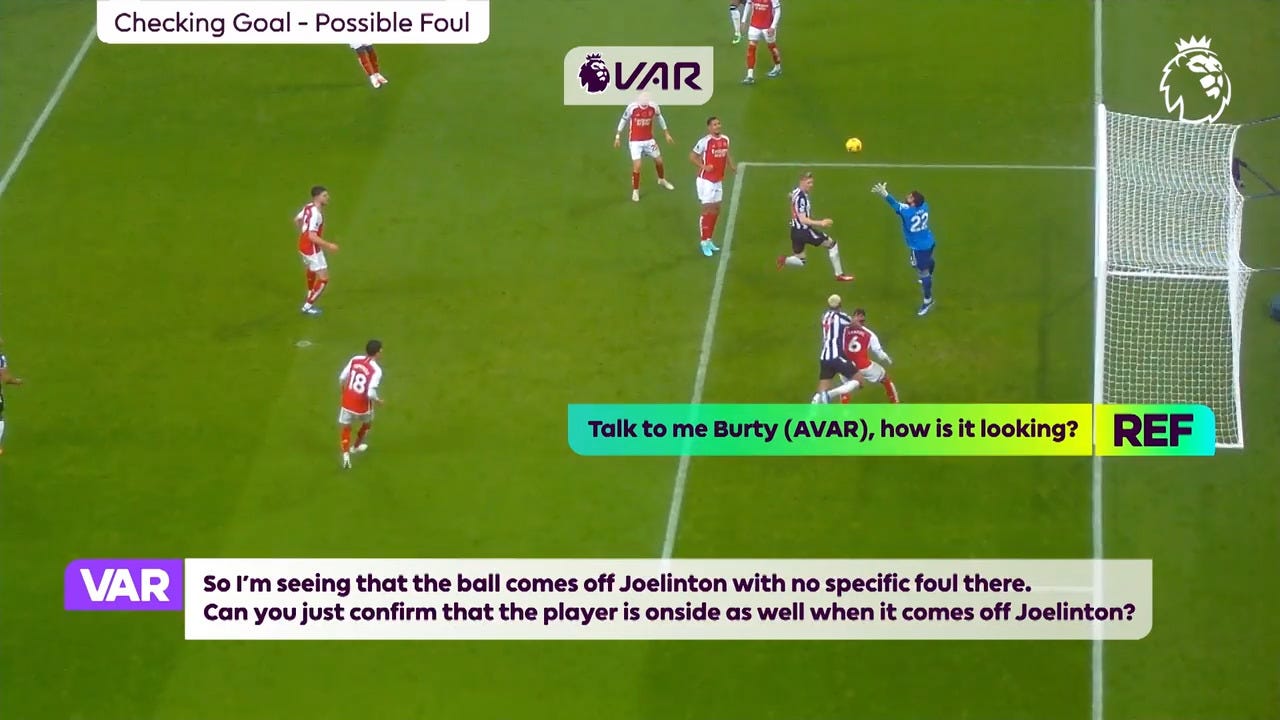
Being a person who doesn’t loathe VAR these days feels like an uncomfortable and minority opinion.
A new survey published this week by the Football Supporters’ Association puts some numbers behind that feeling. In the response, nearly three-quarters of the fans that took the survey came out against the current implementation of Video Review.
When asked ‘taking all things into consideration, do you support the use of VAR in football?’ 75.7% of fans replied ‘No’…
These findings back up the FSA’s previous survey in 2021, where fans expressed misgivings about the introduction of VAR.
The vast majority are reporting the same concerns five years on – the loss of spontaneity when celebrating goals, and an overall worsening of the match going experience.
Spending time around fans and this isn’t a shocking revelation. There is clear frustration with referees in general and VAR in particular. I do think however that it is worth examining deeper into what this survey is and isn't telling us.
The FSA's respondents skew heavily toward older match going fans, a group that trends more conservative toward change and more skeptical of new technology, who also have the worst VAR experience by design, given the lack of replays (a very dumb choice and something that can be fixed) and poor in-stadium communication (although maybe better with the announcements). And like any opt-in survey, it over-indexes on people with strong feelings, because indifference or mild satisfaction doesn't fill out online forms.
That doesn't make the data wrong, it makes it a precise measurement of a specific, activated audience. The headline number, 75% opposing VAR, should be read as the ceiling of opposition among engaged fans, not a census of the whole watching public.
This might overstate the extent to which this is a problem with all fans, it does show that there is an underlying frustration, but I think the details on how the support breaks down with different support for the different usage of technology exposes something more interesting: fans do support technology correcting errors. They just hate this implementation.
I think that this is also something that shows that with the laws of the game and the general “unwritten” interpretations complicate the ability to officiate this game in a satisfactory way.
Fans Aren't Anti-Technology, They're Anti-Subjectivity
The overwhelming support for goal-line technology, with 93% of these same fans supporting its use, plus a near 50/50 split on the usage of offside technology (semi-automated makes a big difference here) show that even people that would skew anti-technology usage are not a monolith in being against the usage of technology to improve accuracy.
Where things break down is when we start getting into more subjective decisions and that is a direct reflection of the rulebook not giving definite black and white lines for most calls and the unwritten rules of how the game has been called a major issue for consistency.
This is evident with the magical place called the penalty box. You can have clear situations where contact that would be an uncontroversial foul just outside the penalty box is something that becomes a coin flip. This is because a foul inside the box gives a team a near certain goal, but it makes a mockery of trying to call a consistent game as a referee.
The result is a different standard inside the box than outside it. That inconsistency doesn't live in the rulebook and you won’t find any reference to it when you read through the laws of the game or any of the supplemental documentation. This is something that referees invented and that VAR has inherited.
This is not in the laws of the game; there is no special “well it’s in the penalty area” clause that raises the level of contact required for a foul to have happened but that is how the game is called, most of the time. This also can make using VAR difficult in the situations where a soft foul is actually given, we fall back to that this is technically a foul, and the VAR won’t hold it to the standards of most other similar situations from the season or even the same match.
This isn’t exclusive to penalty box incidents either, the classic example that always gets me upset is the defender who is in trouble and under pressure who feels the slightest nudge or tap falling over. The referee will give them this bailout call with incredible regularity but the reverse situation with an attacker holding off a defender will not be given that kind of soft touch foul. Again, this can be “technically” correct and defended but makes for inherent inconsistency in the game.
The more subjective the call, the less fans want VAR involved, not because they want errors, but because they know human reviewers have the same issues of trying to enforce a rulebook that doesn’t give us black and white lines. Even something like the Key Match Incidents Panel will often see split votes on if something was or wasn’t a foul/red card/penalty. Unlike a goal/no goal, ball out/in, or player offside/onside decision where there is a yes or no answer, we don’t have that with fouls and that’s not helped by the ways that the laws are written.
This feeds into one of the biggest issues that people have with VAR, that it dampens the spontaneous joy of goal celebrations. I don’t fully connect with this and have not found that I celebrate Arsenal scoring any less, but I understand that this could be an issue for people. The part of VAR that people dislike the most is when it gets into these subjective and inconsistently enforced areas.
It can look and feel like they are looking for ways to disallow a goal and in a low scoring sport that’s brutal. It hurts to have a goal taken away but this is often downstream of the change to play on and review it after, we don’t have the watching a legitimate goal wiped out by a clearly wrong offside flag with no recourse situation anymore.
The subjective calls are always going to be tough and controversial. If you take a foul/no foul play and ask 100 people about it, it would be a pretty rare situation to have all 100 agree. This is a legitimate problem and leads to more time without the game being played, but I think that there are ways that we can do even more to address this and make the system work better.
Refinement, Not Removal
Only 18.3% of the respondents in the survey believe VAR has improved accuracy and that is kind of shocking to me. I believe that these people are reaching a conclusion that the evidence doesn’t support, and I think it tells us more about perception of VAR than the reality.
We know that people like and trust goal-line technology but that is almost now just built in and isn’t viewed as something that has helped improve accuracy. People may not always love close offside calls (and hated the drawing the lines process) but there is no doubt that this has increased the accuracy of these calls, and situations of a player getting incorrectly flagged as offside or scoring from a clear offside position takes a massive blunder rather than it being an every week occurrence.
I think you can even say that clear missed red card type decisions are much better now than they were in the past, these are still subjective calls but the benefit of additional angles and seeing things more than a single time at match speed has led to more correct decisions.
It would be a mistake to lose these important improvements in accuracy, and this is where reform and tweaks to the system should prevail over scrapping the whole thing entirely.
I’d love to see a change to the laws of the game that can give us clearer, more objective rules, that can be evenly applied all over the field and equally to all players. That’s probably unrealistic and we will never truly be able to remove the subjectivity and judgement from this.
Barring that, I think that you can get better outcomes with either better setting of what a clear and obvious error is or moving towards a challenge system.
The current clear and obvious error bar doesn’t seem to work very well. It is something that just seems to add another level of subjectivity and judgement where getting to consistent implementation is going to be hard.
I believe that a system where the referee describes what they saw and the reasoning for the call to the VAR and if that matches what the different angles show then the call is upheld. If it doesn’t that should trigger that they go look at the monitor and see the other angles, I don’t think that they should always change their call like we see now after these reviews.
An example of this is a challenge in the box, where the referee has waved away a penalty. They tell the video assistant, “I saw the player make cleanly tackle the ball and won it fairly and that is not a foul” and if the replay shows that the player didn’t make contact or that they went through the attacker first that would trigger a review at the monitor.
This would probably lead to a few more times where the referee needs to go to the monitor and if we don’t want that I am okay with it and that is where I think a challenge system could work better.
Nearly half of respondents here thought a challenge system would worth exploring and I agree here. This can cut down on some of the constant uncertainty, and it moves the responsibility from the VAR to make a judgement call and these subjective decision to each team.
How many challenges and how the process works would still need to be worked out but I can see real upsides to this proposal. My personal proposal is you get one challenge per match, if you win it, you keep it. I don’t know if this is perfect and I would want to see it tested out in real life scenarios, the details matter but the principle is sound. This limits the overall scope, adds drama, adds strategy and keeps decisions with the on-field referee.
Ultimately, the goal is making VAR more like goal-line technology: fast, clear, binary where possible. VAR isn’t perfect and that is much more because the VAR problems are human problems. If you remove VAR from the game, you don't remove the errors. You just make them permanent and lose the gains in accuracy that we have seen.
It hasn’t been a panacea that fixed everything in the game, but it should have never been viewed as trying to do that. It has been a net positive to the game overall but it can and should still be made to work better.
another way to run the challenge system is that if your wrong, you lose a sub, if you've used your subs, you lose a player.....
But even from last nights small sample survey of 5 games, there were at least 2 game changing incidents that wouldv'e been overturned, Sp@rs not being given a Pen at Anfield ( just like the good ol days ) and Ipswichs 2nd goal.
I think too many fans have these incredible rose tinted glasses on and forget how many mistakes were made.
It would be nice, if time consuming, to review the season before VAR, and see just how many goals were allowed & disallowed....
I think the former player pundit class 'poisoned the well' for VAR, as for them, it's part & parcel, probably because they don't care as much as us fans...
I think what VAR also highlights is how extreme and archaic the penalty rule is. Penalties either need to be awarded for a smaller more severe offenses or penalties need to be made harder to score.
If the sport was high-scoring it would be one thing but currently you have a situation where something like a player accidentally handling a ball on a corner leads to an 80% chance of a goal.
That is an absurd and unfair punishment and leads to a situation that promotes gamesmanship and diving, makes reffing harder, and enrages fans towards refs. I think making penalty box offenses less connected to close to an automatic goal would do a lot to help.