

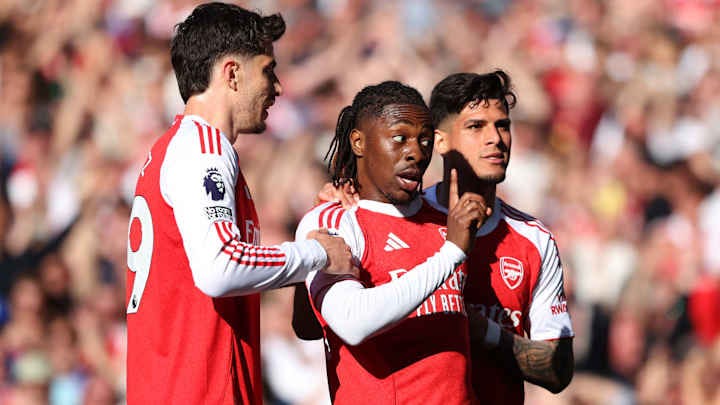
Happy Monday all, Scott continues to prioritize things like “friends” and “family” and is traveling so you’re stuck with me this Monday.
At times of late, things have just been so busy that there’s almost no time for either of us to get too lost in our thoughts — we’re running family shuttles to and from practices, completing big projects around the house, traveling across the country to attend family events and so on. Heaven knows in my house, we’ve got birthdays for four kids (two still with us, two passed on) in a mad dash from the end of February through the first of May. This week also brings the beginning of another soccer season for my son, which of course means I again don my reflective sunglasses and whistle and do my best to age young men, as it were.
As it happens, I watched the last 30 minutes of Saturday’s Newcastle-Arsenal clash on my phone from a different soccer practice for my son, glancing up and down to watch him make plays while also keeping a close eye on proceedings in London. Far from the first time this season, and I’m sure it won’t be the last over the coming years.
I didn’t really set out to tell you all about my daily schedule here, rather to make the point that things are busy, and while I’ve had so many thoughts about the experience of this season, some of them pretty repetitive, I haven’t had as much time to organize them as I’d like.
Then there’s the tension. As a content creator, for lack of a better term, sometimes it’s easy to dwell in the sanctuary of recurring pieces, as I’ve done with my player rankings that drop weekly or so. But on the topic of reactive or analytical pieces, I admit I’ve been feeling a bit of a paralysis lately. Things have changed pretty rapidly week to week, and we can talk all we want about trends and underlying data, but there’s also the element of…we just don’t know what will happen, and we’re all pretty anxious at this point to reach the end of this and discover our fate.
As we experience this journey, I’ve seen every reaction you could think of, from “this shouldn’t be like this and damn everyone in control for putting us through this” to “actually, it’s pretty impressive we’re still here, all things considered.” Lately I’ve found myself thinking about that contrast of opinions specifically, and while I won’t set out to write in depth on any of this today, it’s left me with a few thoughts I think are worth digging into a little below:
The whole injury thing
It feels like it’s been a long time since we’ve been able to say Arsenal weren’t dealing with a weird number of injuries. Even Saturday, we lost Eze and Havertz and tails immediately tucked between legs, assuming that Kai was done for the season, taking with him any hope Arsenal have of winning anything.
But even that small thought in and of itself introduced a kind of cognitive dissonance we’ve been living with as a fanbase for the better part of two seasons. I posted a bit about it over the weekend, but we got Bukayo Saka back on Saturday after about a month on the shelf. We’re still waiting for Calafiori and Timber and Merino, but I’ll set them aside for now.
Saka is, to me, unquestionably the best player Arsenal have. That’s backed by the years-long panic that his current contract in any moment will be his last at Arsenal, lest we prove to him we can win things. And this weekend’s appearance was his first in the Premier League since March 14, his first in any Arsenal match since the EFL Cup final five matches ago.
Unbelievably, the player many once feared would be ground into dust under the thumb of Mikel Arteta has made just 22 Premier League starts this season, 32 across all competitions. He’s seventh among outfield players in minutes played, behind even Viktor Gyökeres. Even if Saka starts all of the maximum seven matches remaining this season, he would end this season on 69 all competitions starts (nice). For contrast, Federico Valverde has started 106 matches since the beginning of last season. Erling Haaland has started 89. Bruno Fernandes, whose club aren’t even in Europe this season, has started 86.
Of course, Arsenal have had other big injury issues. Martin Ødegaard has made 12 fewer starts than Saka this season and Kai Havertz has started 22 fewer — and to me, those three represent Arsenal’s first and second best attackers and their best creator, for what that’s worth. But just forgetting that for a second, whenever Arsenal come under the microscope for their performances of late, I find myself coming back to this Saka question. Using the above Haaland and Bruno as examples, what would we expect of City and United’s performances if they missed 20 more games than they had? Would we expect those sides to perform as they did with those players, in City’s case remaining in the Champions League and staying atop their domestic league? Would we expect United to remain favorites for third? And if not, why has the expectation for a Saka-less (and Ødegaard-less, for many of the same games) Arsenal to not only stay first, and stay in the Champions League, but to show out and offer their best form of the season? Food for thought.
Needless to say, keeping Saka on the pitch could be a big deal for what remains of the season. As we saw immediately upon his introduction Saturday, he makes a difference.
Reverting to how I began this section, it feels like Arsenal have dealt with a great deal of injuries over the past two seasons, right? I’ve even seen it suggested that this has gone on longer than that. To be clear, Arsenal have absolutely been injured a lot this season and last. Per Premier Injuries, the club suffered the fourth-most time-loss injuries last season (data not yet available for this campaign), but that’s where the outsized injury issues do end. In 23-24, Arsenal were second from bottom in time-loss injuries. In 22-23, third from bottom. As in, having the fewest.
But why does this keep happening? It’s not as simple as 1+1=2 (if it were, building such a deep squad would’ve fixed it), but one domino that has repeatedly set things into motion that needs to be acknowledged, as unsatisfying as it is — shit luck.
When Kai Havertz was clattered into in August, breaking bones in his knee that would keep him out until December or January, that wasn’t an overuse issue. In fact, he’d just come off the bench. Same for Ødegaard getting his ankle rolled in a friendly against Slovenia last season, or getting into a vicious knee-to-knee with Crysencio Summerville this season. And you don’t even need to mention how uncontrollable Mikel Merino’s collarbone or foot breaks in training or Gabriel Jesus’ and Jurrien Timber’s ACL tears were.
But those injuries, crappy luck as they were, came with knock-ons. Ødegaard missed a busy stretch last season at the same time as Merino with his collarbone. That thinned Arsenal’s midfield options and created a lot of work for Declan Rice and Kai Havertz, while also thinning Arsenal’s options at 9. When Timber tore his ACL, that created a body of work that likely contributed to Ben White’s thigh injury, which cost him time last season, further catapulting Timber into a big workload last season and this (and now he’s dealing with a muscle issue, naturally). Havertz’s contact injury this summer essentially forced Gyökeres and Jesus minutes that may not have even happened this season had things gone to plan, let alone driving reduced attacking output in the side.
I’ve certainly seen it suggested before that this could be addressed through squad build, adding more pieces, but it’s hard for me to get on board with the idea that Arsenal’s three left backs, three strikers, 8 or 9 midfielders, two very good right backs, etc., are a thing group. And while there’s been some sentiment that Kai Havertz is “glass” or Ødegaard can’t be relied upon, what’s happened these past two seasons is an outlier for both.
In fact, you may remember Havertz being praised by Mikel Arteta for almost never being injured just last season. And the 63 games he’s missed over the past two seasons are a shift from his career trends and then some.

Ditto Ødegaard, whose ankle roll cost him 14 games last season, as many or more games than he’d missed in every other season to date than one. By the way, as he’s gained a rep these days for being inconsistent…he also only missed one more game last season after returning in December.

But that’s then, this is now, right? Can these two be counted on? That’s the question Arsenal’s physios and front office will have to do their best detective work on to answer. Are Havertz’s knee injury — which accounts for nearly half of his time missed of late — and Ødegaard’s rolled ankle and clashed knee injury — more than half his time missed right there isolated incidents, or have they set off a chain of injury problems that do happen to some athletes as they age? Honestly, it’s impossible to say.
Ekeing it out
This is another one I touched on via social media earlier this weekend, but the concept of barely hanging on to wins has followed me throughout this season. The narrative even goes back to the good times, such as a 1-0 October win over Palace where Arsenal conceded 7 shots and less than half an expected goal - about half of that coming from one shot.
Or there’s a December win at Everton where Arsenal conceded five shots, the last coming at 78 minutes. A week later, Arsenal beat Brighton 2-1 in a match where the Seagulls took four shots after a very lucky bounce let them halve the lead in the 64th minute. These wins were largely dominant and involved Arsenal snuffing out chances on the other side but were not considered by many Arsenal fans and talking heads to be “Good Wins.”
We’ve seen this rise to prominence again lately, be it Arsenal’s controlled two-leg win over Sporting, the draw away to Leverkusen, against Chelsea in the Carabao, Saturday’s result or even the return leg with Brighton, where Arsenal defended a 1-0 lead for 81 minutes but Hurzeler’s men didn’t even get a shot off after the 69th minute.
It’s so, so easy to understand why it’s more fun to win by two goals or three (hell, four) rather than one. One is what an American football pundit might call a “one-possession game.” But digesting all of this information led me to post the below this past weekend:

As I said, like everyone else I will never prefer a one-goal win, particularly in the moment. But another thing worth thinking about - particularly as we enter an age of Premier League talent compression and the potential further reduction of overall goal production, especially from open play - is what under siege really looks like, versus closing out a mostly uneventful one-goal win.
(Note: I have thoughts about how this is impacting attackers’ output and whether players are actually “off” versus just facing more obstacles, but that’s for another day.)
Of course, all it takes is a moment, one mistake. But those come more frequently when you’re not snuffing out the majority of chances before they really get started.
What the heck is gonna happen?
Man, I wish I knew. But Saturday, whether you hated the performance or not, was a huge three points. 20% of what was available from there out. Newcastle are 14th but they’re good, and just got Bruno G back.
By the time the match with Fulham ends next Saturday, Arsenal will have played two matches more than City, just three to go. Potential is there to be six ahead when City-Everton kicks off on the 4th of May, but then City also play Brentford before Arsenal kick another PL ball. So you could go from tied, to six ahead, to tied again, in pretty short order.
It’s going to be a wild ride, with odds fluctuating too much for comfort, and too many scenarios and permutations to count. The biggest thing at this point is to just win…no style points up for grabs here.
It “seems” as if most of our games recently are one goal games—which I use to include a 2-3 against ManU, and a 0-0 against Sporting and a 1-0 against Newcastle—which are actually very different outcomes. Games that seem like single possession games for getting a point, or not getting a point, or getting 3 points. But I’m not sure if I am responding to an underlying truth about football—that most games are close or am I right, and it’s only Arsenal that has this many close games? The last 3 rounds of games in the PL have had 3, 2, and 4 games that were decided by more than one goal. Arsenal has had one game in the last 10 league that was more than one goal difference (Everton), but 5 in the last 16 in all competitions. Are we just overlooking a basic truth about the sport and we should be more accepting of the painful knifes edge of one point games until the season is over? How many games are one goal games because that’s the sport? I appreciate your writing and your general calmness.