

I apologize for the slow down in content lately, I have been heavily focused on upgrading the way that I managed data and that has been a really big project taking up a lot of my free time. It should address and add additional context that I think is very important and will be able to make the analysis that Adam and I do here better.
I will put together at the very end a full breakdown of all of the changes, but as a bit of a preview I am going to go through a few of the upgrades and research that I am doing along the way.
Today I am going to start with the addition of “garbage time.”
What is Garbage Time?
This is a concept that originate with NBA basketball, “garbage time” is the term that describes late game situations where the stats and performances aren’t really reflective of a normal competitive game. It is those final minutes of a blowout when the outcome is certain, coaches rest their stars, and the game is just played out to the final buzzer.
This has been adapted to American Football and baseball, but for the most part it has not been adopted very widely into soccer.
For most matches in the Premier League this is not something that will occur a lot, but it does happen often enough that it I believe that it is valuable to identify these situations because they alter the way that the match is played and resulting stats would reflect those same distortions.
The Cannon Stats Definition: Garbage time occurs when a team’s win probability reaches 99% or higher in the second half. At this threshold, the match outcome is all but statistically certain, even though play continues.
Finding when Garbage Time starts
To identify exactly when matches enter garbage time, I went through my database of matches, in total I had 24,973 matches from Europe’s top five leagues from 2011 through 2026, tracking minute-by-minute game states and the final results that they led to from 2011 through 2026.
The Results
There are three clear thresholds where win probability crosses 99%:
+4 or more goals from the start of the second half (It technically starts as soon as you go +4 but I am limiting this to the second half).
+3 starting in the 57th minute.
+2 starting the 87th minute.
Here is how the probability of winning looks for each game state over the course of the second half.
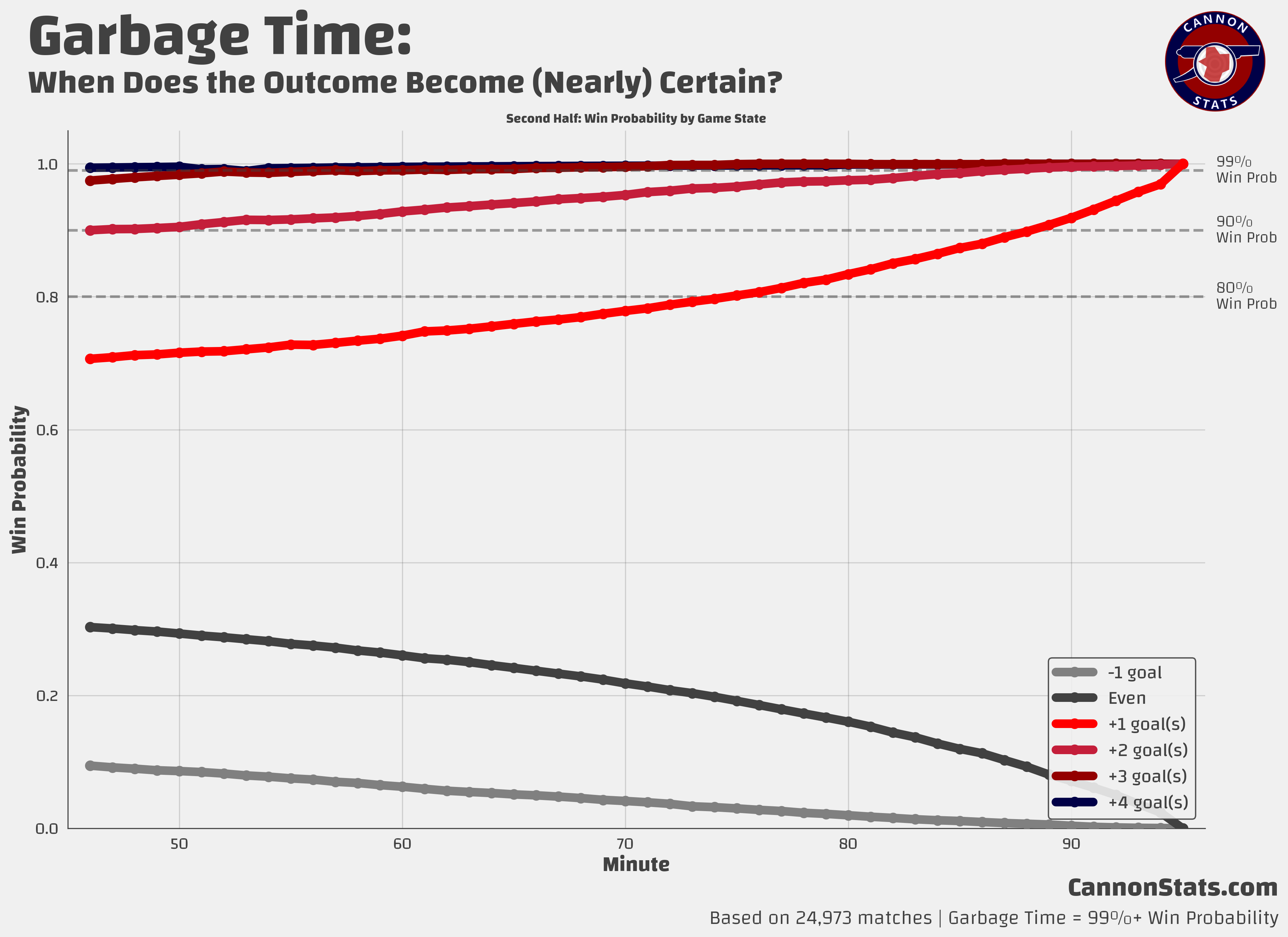
There is not a lot separating +3 and +4 or more here, but there are just enough times where a team has come back from it that this doesn’t kick in until a bit later into the second half.
This generally matches the vibe from watching a match as well, even if a team is up 3 goals the first 10 to 15 minutes of the second half are played at a competitive level and it is after that 55 to 60-minute mark where you see teams start bringing on subs and the overall intensity dropping down. This is similar for if the match is at just +2, and third goal is scored in that 55 to 65 minute zone where everyone starts treating it like it is game over.
Even though 2-goals is the cliche most dangerous lead, it really isn’t that way. For the entirety of the second half this is a 90+% to win game state on average. This does still take quite a while to rise to near certain win however because it just takes one moment to have a team get back into the match. It is a slow steady climb throughout the second half, and it finally crosses the threshold at the 87th minute.
I want to be a bit more conservative with this definition and I like round numbers, so I am going to set the rules like this:
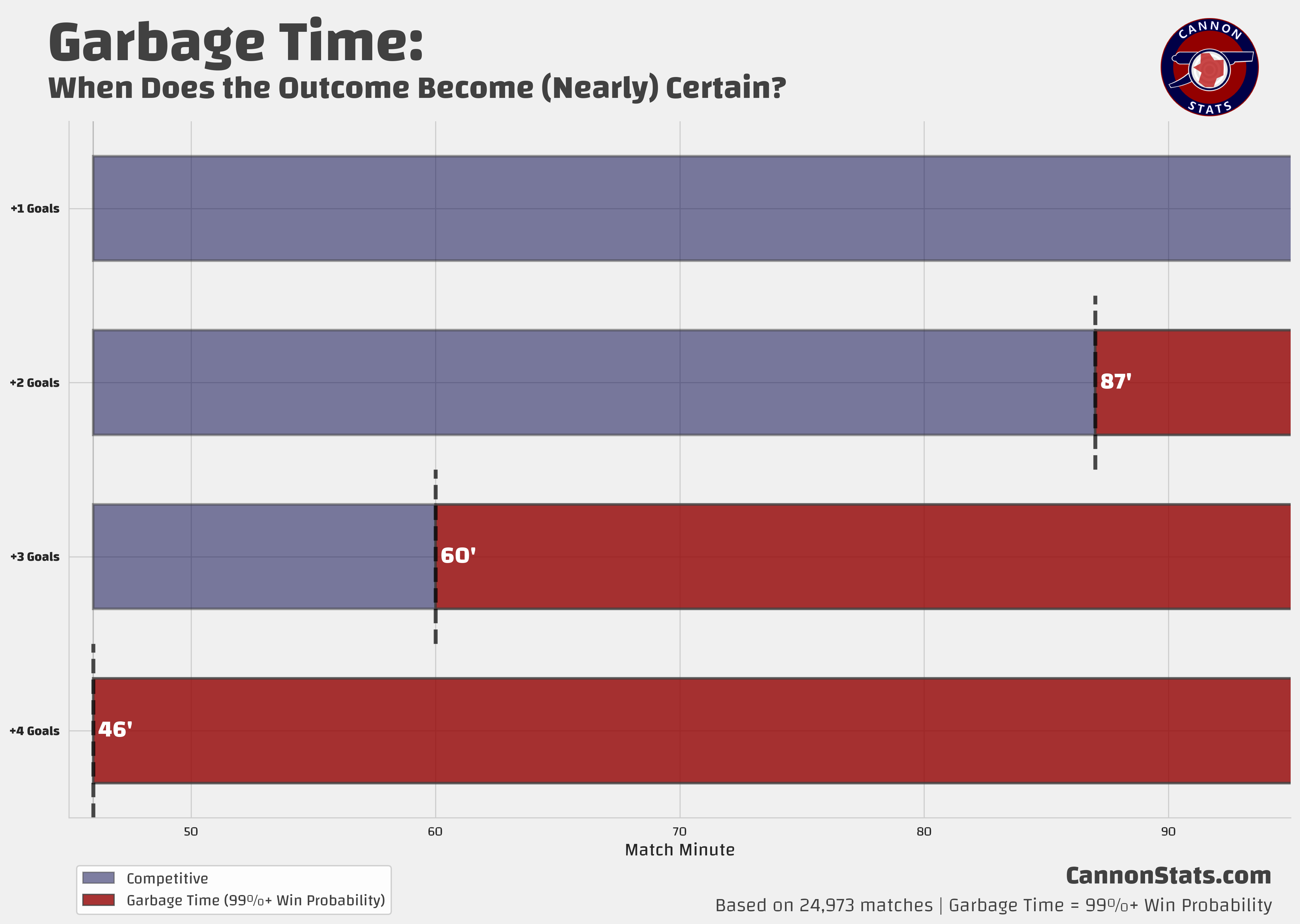
+/- 1 goal is always a competitive game state.
+/- 2 goals from the 87th minute to the end of the game is garbage time.
+/- 3 goals from the 60th minute to the end of the game is garbage time.
+/- 4 goals from the start of the second half is garbage time.
Some examples:
A team is winning by 3 goals in the 50th minute and scores bringing the lead to 4, everything after this (while the margin is still above the threshold) is now garbage time.
A time is winning by 3 goals in the 70th minute and the opposition pulls one back to bring it down to 2, the time from 60-70 was garbage time but everything from the goal until the 87th minute would revert back to competitive time.
Why This Matters
Having the ability to filter out competitive and non-competitive time is important because this will affect how teams and approach a match.
This changes even at smaller margins but in a way that is more “normal” and still competitive. A team that is winning by a goal, will probably get a bit more risk adverse with the opposite true for the team that is down. But when the margins grow really large and the outcome of the match is no longer in doubt, the effort/tactics/substitutions change drastically.
A striker who bags two goals when his team is already up 3-0 at 75 minutes looks great in the box score. But those goals came in garbage time, with defenders who might be checked out or with a team that is gone to a very aggressive style pushing everything forward in a last-ditch attempt to get back into the game. These goals still count and we should still track them, but there are situations where when you are doing analysis that it would be helpful to limit this to only situations where the game is competitive.
I don’t anticipate that this will be revolutionary for changing our understanding of teams and players, but this is a nice tool in the toolbox that can help us better understand the game.
Not all minutes are created equal. Not all goals mean the same thing. And not all statistics tell the truth without context. Having this built into everything from the start will be a big help to making sure that we can do that more often.
Perfect timing. Today's 2nd half vs Wigan is a perfect example of garbage time.
after yesterday arteta obviously needs to raise the quality of the gunner's "garbage time".