

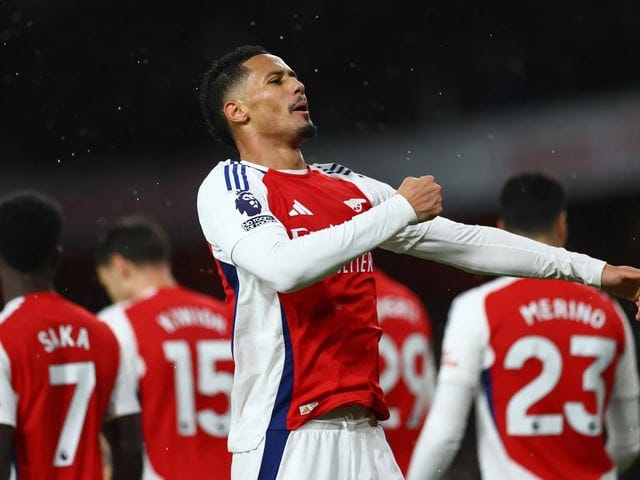
When reports emerged that William Saliba had returned to first-team training, the reaction from Arsenal supporters was entirely predictable: relief.
For months, the conversation around Arsenal’s defense has been defined by absence. How do Arsenal cope without Saliba? Can they survive until he returns? Has the title race become more difficult because one of the world’s best defenders isn’t available?
Now the conversation is changing.
Not because Saliba’s importance has diminished. If anything, the last several months have reinforced just how valuable he is. Rather, his return forces Arsenal to confront a very different question. After signing Ezri Konsa this summer and watching him establish himself as a trusted option, Arsenal suddenly appear to have three players who could reasonably start for a title contender.
Gabriel remains one of the first names on the teamsheet. Saliba is returning. Konsa wasn’t signed merely to provide emergency cover.
Three starters. Two positions.
Well, at least in theory.
Arsenal Have Earned This ‘Problem’
Before getting into the complications, it’s worth acknowledging the obvious: this is a much better problem than the one Arsenal faced at the end of the 2022-23 season.
Whether one believes Saliba’s injury was the sole reason Arsenal fell short that year or not, the team looked fundamentally different without him. Arsenal suddenly had a position opponents could target, and much of the confidence and stability that had characterized the title challenge began to disappear. More recently, Arsenal have again spent months trying to navigate life without arguably the best right-sided center back in world football.
The club doesn’t need convincing that defensive depth matters. It has learned that lesson multiple times.
That’s why the logic behind the Konsa signing was always relatively easy to understand, even for those of us who had reservations about the deal. The concerns I wrote about earlier this year weren’t really about the player. They were about the timeline, the fee and what the move potentially meant for younger players already in the squad.
As a footballer, Konsa makes perfect sense. Seven-plus years as a Premier League starter. Excellent durability. Positional versatility. Trusted by every manager he’s played under. If you’re trying to maximize a title window over the next several seasons, those are attractive qualities.
The move made perfect sense when Saliba was unavailable.
The more interesting question is what happens when everyone is available.
The Challenge Every Elite Club Eventually Faces
The funny thing is that when I started thinking about this question, Arsenal wasn’t actually the first team that came to mind.
It was Bayern Munich. The German champions currently have Dayot Upamecano, Kim Min-jae and Jonathan Tah, and they subbed off one for another at 60 minutes when Arsenal visited last month. That’s not necessarily a wild sub, but it’s not a super common one.
Real Madrid have spent recent years balancing Antonio Rüdiger, David Alaba and Éder Militão. Every elite club eventually reaches a point where it convinces itself that three top-level centre backs are better than two, and in many ways that logic is difficult to dispute. Injuries pile up, schedules become increasingly absurd and a position that once required two starters now effectively requires three.
The challenge is that centre backs are not wingers. Managers can rotate wide forwards in and out of the lineup while maintaining much of their attacking structure. Centre backs tend to be different. Familiarity matters. Partnerships matter. Understanding how a teammate reacts under pressure matters. There is a reason managers routinely talk about defensive chemistry in ways they rarely discuss attacking chemistry.
At some point, somebody usually becomes the third option…Or a manager finds another solution.
The Manchester City Model
If there is a club that has genuinely cracked this problem, it is probably Manchester City (legality notwithstanding).
What’s interesting is that Guardiola didn’t really solve the issue by endlessly rotating centre backs. Instead, he stopped treating certain defenders as only centre backs.
Nathan Aké became a left back. Manuel Akanji became a right back. John Stones started appearing in midfield. Joško Gvardiol cycled between different defensive roles depending on the opponent and tactical setup, to the point where I lost track of whether I should rank him as a fullback or CB.
The lesson isn’t merely that City stockpiled defenders. It’s that City found additional jobs for them — of course, much to your buddy on Twitter’s delight.
The best version of the three-centre-back model isn’t three players competing for two positions. It’s three players creating solutions across four or five positions.
Which brings us back to Arsenal.
Is This Really Three Players for Two Positions?
The thing I can’t quite shake is whether Arsenal’s situation is actually as straightforward as it appears.
A lot of the discussion surrounding Saliba’s return assumes Gabriel, Saliba and Konsa are interchangeable pieces. But we’ll see whether Arteta sees them that way.
Throughout his tenure, Arteta has generally shown a preference for maintaining natural profiles across his defensive line. The clearest example remains the closing months of the 2022-23 season. Following Saliba’s injury, many supporters wanted Jakub Kiwior moved into the right-sided centre-back role sooner than he ultimately was. Instead, Arteta persisted with Rob Holding for a significant period.
There were undoubtedly multiple factors behind that decision, but it was difficult to avoid the conclusion that Arteta placed real value on having a natural right-sided defender operating on the right side of his defense.
That history could matter when trying to project what comes next.
Gabriel is effectively Arsenal’s established left centre back. Saliba is naturally a right-sided centre back. Konsa is also most comfortable on the right side. If Arteta continues to view the positions in those terms, Arsenal may not actually have three centre backs competing equally for two roles. It would, of course, be much easier to view Saliba, Konsa — or even Mosquera, who has LCB experience from Valencia — as options on either side.
They may have Gabriel occupying one position while Saliba and Konsa compete more directly for the other. That’s a much more difficult dynamic to manage.
The Konsa Variable
Which is why I keep coming back to Konsa’s versatility.
The easiest solution may be that he doesn’t need to be competing exclusively for centre-back minutes in the first place.
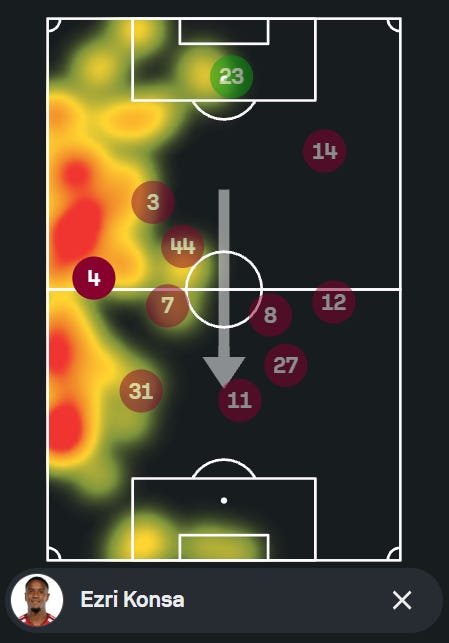
One of the reasons Arsenal targeted him was likely his ability to play right back. He’s comfortable defending wider spaces, has the athletic profile to handle difficult matchups and brings a level of reliability that managers tend to love. The more interesting question is whether Arteta views him as a genuine option there when everyone is healthy.
Ben White’s role has evolved into far more than simply defending. At various points he has become a key supporting piece alongside Bukayo Saka, an important buildup player and a contributor to Arsenal’s attacking structure. Jurrien Timber has done likewise, though until recently his contributions going forward were more reserved for setpieces. This season, his open play attacking has improved much to everyone’s delight.
Konsa would change the profile of the position. Arsenal would almost certainly become more defensive in certain phases, but they might not sacrifice as much attacking value as many assume. If that proves true, the entire puzzle suddenly looks different — Arsenal aren’t squeezing three defenders into two shirts. They’re distributing three elite defenders across multiple positions, which begins to resemble the model City have used with considerable success.
Then There’s Mosquera
One of the reasons I found the Konsa deal so interesting in the first place was that Arsenal had already invested in what appeared to be a long-term deputy/succession plan.
Mosquera isn’t a teenager who needs four years of development. He’s a young first-team defender whose pathway once looked relatively straightforward. Learn behind established players. Accumulate minutes. Eventually push for a larger role.
The addition of Konsa complicates that picture.
Maybe that’s perfectly acceptable. Modern football increasingly rewards teams that stockpile defensive talent and sort out the consequences later. Looking around Europe, it’s difficult to argue that elite clubs have too many quality defenders. Injuries and fixture congestion usually solve those concerns on their own.
At the same time, there has to be a pathway somewhere. Otherwise clubs risk repeatedly purchasing succession plans before earlier succession plans have had a chance to succeed.
Perhaps Arsenal see Mosquera as Gabriel’s eventual successor. Perhaps they simply believe there will be enough minutes to go around, due to the uncertainty of life itself. Perhaps somebody eventually leaves and creates a clearer opening. I genuinely don’t know what will happen.
What I do know is that Saliba’s return makes those questions much more timely than they were a few months ago.
A Different Kind of Problem
For months, Arsenal supporters were focused on surviving without one of their most important players.
Now the focus is shifting toward something far more interesting: how Arteta intends to manage a defensive group that suddenly appears overloaded with starting-level talent.
That’s a good problem to have. But it’s still a puzzle that needs solving.
The best clubs in Europe increasingly collect top-level defenders because they understand how fragile title challenges can be. Arsenal seem to have reached that stage. The challenge now isn’t finding enough quality. It’s figuring out how all of that quality fits together.
And if Arsenal get that answer right, Saliba’s return may end up strengthening the squad in ways that go well beyond simply putting one of the world’s best defenders back on the pitch. What a nightmare that must be for everyone trying to keep up.
It also allows Timber to play at LB as a different defensive look with Konsa or White at RB. Arteta seemingly liked that look in the past although that was before Hincaipe’s arrival. 4 LBs who are very different and suddenly on the right side we won’t see a game but undercooked Mosquera or an unfit Timber playing against PSG in a CL final. If Arteta looks back at the CL final he must wonder how he ended up with the patchwork lineup that almost won.
Play a back 3 And allow the normal lb and rb to man mark certain attackers and roam all over. Break the structure expectations of the opposition.